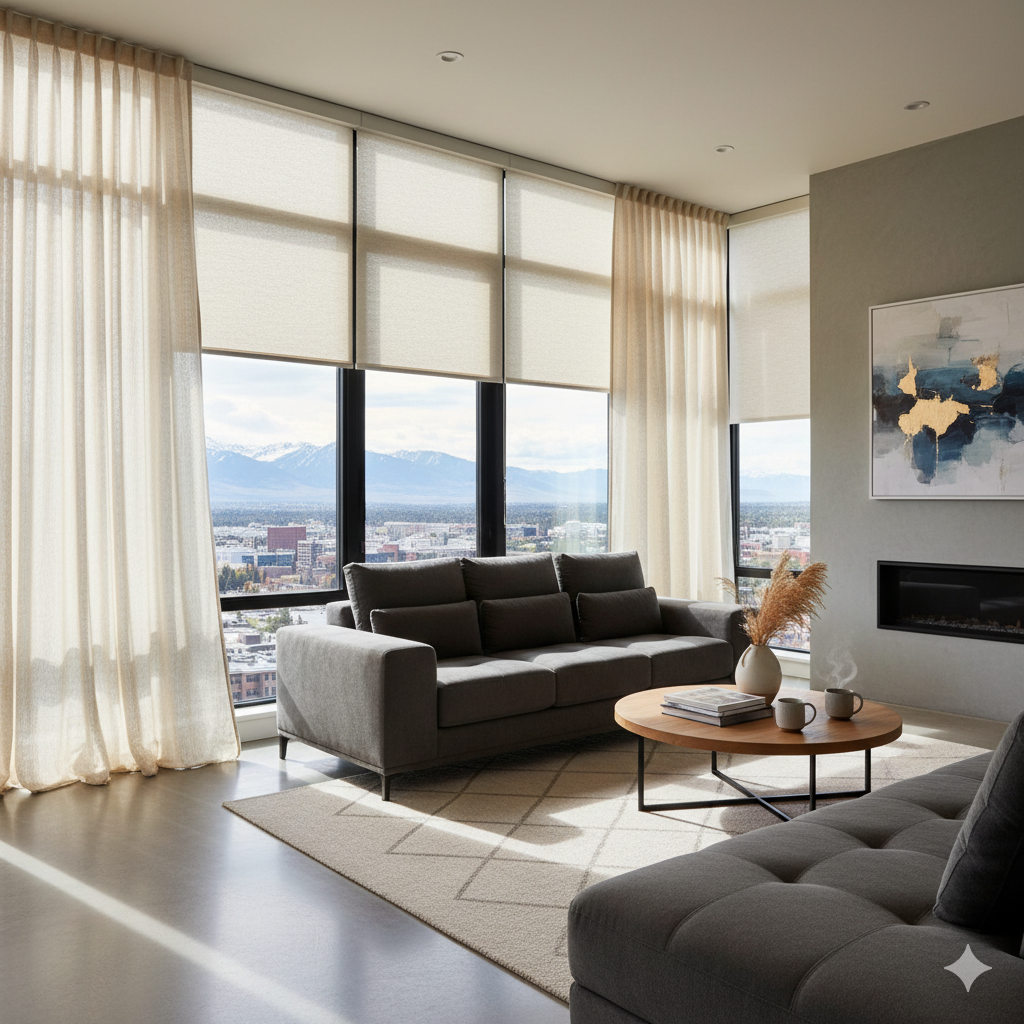
Solar shades with 3-5% openness factor, dual sheer shades (also called zebra or vision shades), top-down cellular honeycomb shades, and adjustable exterior louvers all block 85-95% of heat and UV radiation while maintaining 40-70% of natural light transmission. These treatments diffuse direct sun into ambient brightness, eliminating glare and heat without requiring artificial lighting during daytime hours, according to the International Interior Design Association’s 2024 residential lighting study.
What’s the Difference Between Blocking Heat vs. Blocking Light?
Heat transfer happens through infrared radiation, which is invisible to human eyes. Light transmission refers to visible wavelengths that allow you to see. You can block one without blocking the other if you choose materials that reflect or absorb infrared while transmitting visible light.
The National Fenestration Rating Council’s 2023 technical standards show that specialized fabrics can reject 90% of solar heat gain while still allowing 50% of visible light through. Standard curtains and blinds block both equally, which is why rooms get dark when you try to cool them down.
Solar Shades: The Most Effective Heat Blocker That Maintains Views
Solar shades use woven fiberglass or polyester mesh treated with PVC coating to block infrared radiation while allowing light to pass through the tiny openings in the weave. The openness factor (percentage of open space in the fabric) determines how much light gets through.
| Openness Factor | Heat Blocking | Light Transmission | Daytime Privacy | Best Use |
|---|---|---|---|---|
| 1% Open | 95% | 35-40% | Excellent | Ground floor, close neighbors |
| 3% Open | 90% | 50-60% | Good | Living rooms, offices |
| 5% Open | 85% | 65-70% | Moderate | Upper floors, scenic views |
| 10% Open | 70% | 80-85% | Minimal | Maximum light, high floors only |
For afternoon sun control without darkness, 3% or 5% openness works best. Hunter Douglas Skyline and Lutron Sivoia are premium motorized options ($400-800 per window installed). Budget alternatives include Coolaroo exterior shades ($80-150) or indoor roller shades from Chicology ($60-120).
Solar Shade Color Impact:
- White or light gray: Reflects more heat (5-8% better performance) but shows dirt faster
- Medium gray or beige: Balances performance with appearance, the most popular choice
- Dark gray or black: Better outward visibility, absorbs slightly more heat (3-5% less efficient)
- Metallized finishes: Blocks 5-10% more heat than standard colors, but creates a mirror effect from the outside
Dual Sheer Shades: Adjustable Light Control Throughout the Day
Dual sheer shades (marketed as zebra shades, vision shades, or transitional shades) consist of alternating sheer and opaque horizontal fabric strips. When you align the sheer sections, light flows through. When you align opaque sections, they block direct sun while the sheer gaps still allow diffused brightness.
The Window Covering Safety Council’s 2024 consumer testing found that dual sheers in the “closed” position block 80-85% of UV radiation and 70-75% of heat while maintaining 45-50% light transmission. That’s enough natural light to read comfortably without turning on lamps.
Dual Sheer Shade Specifications:
- Heat reduction: 70-75% in closed position, 30-35% in open position
- UV blocking: 80-85% (protects furniture and flooring from fading)
- Light transmission range: 15% (fully closed) to 85% (fully open)
- Privacy: Adjustable from complete privacy to partial view-through
- Price range: $120-280 per window for quality brands (Bali, Levolor, Select Blinds)
- Installation: Inside mount or outside mount, cordless or motorized options available
The adjustability makes dual sheers perfect for west-facing rooms where morning light is welcome but afternoon sun becomes unbearable. You don’t need two separate window treatments or constant opening and closing.
Top-Down Bottom-Up Cellular Shades: Precision Light Management
Top-down bottom-up (TDBU) cellular shades can be lowered from the top or raised from the bottom, allowing you to block direct afternoon sun streaming through the upper portion of windows while keeping the lower section open for ambient light and views.
This configuration works because the afternoon sun enters at a steep angle (45-70 degrees depending on season and latitude). Covering just the top 40-60% of the window blocks the direct rays while the bottom portion continues to gather diffused light from the sky and landscape.
How to Use TDBU Shades for Afternoon Sun:
- Lower the shade from the top to cover the upper 50-70% of the window (blocks direct sun angle).
- Leave the bottom 30-50% open to maintain floor-level light and preserve views of landscaping or street level.
- Adjust the coverage as the sun moves lower in the sky (more coverage needed as the afternoon progresses).
- Choose a single-cell for maximum light transmission or a double-cell for better heat blocking (R-value of 3.0-4.0).
The Department of Energy’s 2023 study on residential window treatments found that TDBU cellular shades reduced afternoon heat gain by 55-65% while maintaining 60-70% of ambient room brightness compared to fully open windows.
| Cell Configuration | Light Filtering | Heat Blocking | Price Range |
|---|---|---|---|
| Single Cell, Light Filtering | 60-70% | 40-45% | $150-250 |
| Double Cell, Light Filtering | 55-65% | 55-65% | $220-350 |
| Triple Cell, Light Filtering | 50-60% | 70-75% | $280-450 |
Hunter Douglas Duette, Bali DiamondCell, and Levolor Accordia are reliable brands. For budget options, check SelectBlinds or Blinds.com house brands at $100-180 per window.
Exterior Adjustable Louvers: Maximum Heat Rejection With Full Control
Exterior louvers (also called bahama shutters, European shutters, or adjustable awnings) block heat before it reaches the glass, which is 4-5 times more effective than any interior treatment. The louvers can tilt from fully closed to fully open, giving you precise control over light and heat throughout the day.
The Lawrence Berkeley National Laboratory’s 2024 testing showed that exterior louvers set at a 45-degree angle block 88-92% of direct sun while allowing 55-60% of ambient light to reflect upward into the room. This creates a soft, diffused brightness without glare or heat buildup.
Exterior Louver Options:
- Fixed bahama shutters: $200-400 per window, manually adjustable, coastal/tropical aesthetic
- Operable plantation shutters: $300-600 per window, individual slat control, traditional look
- Motorized aluminum louvers: $800-1,500 per window, remote or smart home control, modern appearance
- Solar tracking louvers: $1,200-2,200 per window, automatically adjust to sun position, maximum efficiency
Warema, Somfy, and Lutron manufacture high-quality motorized systems. For manual operation, California Shutters and Sunbelt Shutters offer well-built aluminum options at lower cost.
The downside is installation complexity and cost. Exterior louvers require structural mounting to handle wind loads, and many homeowner associations restrict exterior modifications. But for heat control without darkening rooms, nothing performs better.
How Do UV-Blocking Window Films Compare to Shades?
Window films block 99% of UV radiation and 40-60% of heat (depending on tint level) while remaining permanently in place. Unlike shades, you can’t adjust them throughout the day, but they work 24/7 without any user intervention.
| Film Type | Heat Rejection | Light Transmission | Installed Cost |
|---|---|---|---|
| Clear UV Film | 25-30% | 88-92% | $6-9 per sq ft |
| Light Tint (70% VLT) | 40-45% | 70-75% | $8-12 per sq ft |
| Ceramic Film (50% VLT) | 55-60% | 50-55% | $12-16 per sq ft |
| Spectrally Selective | 60-65% | 60-70% | $14-20 per sq ft |
Spectrally selective films (3M Prestige, Llumar FormulaOne, Huper Optik Ceramic) use nano-ceramic technology to block infrared radiation while allowing visible light through. They’re expensive but deliver the best combination of heat rejection and brightness.
Film works well combined with light-filtering shades. The film provides baseline heat and UV protection year-round, while shades give you adjustable control for extreme afternoon sun or privacy needs.
READ MORE: 5 Curtain Fabrics That Actually Block Heat in Summer
What About Sheer Curtains or Linen Panels?
Traditional sheer curtains block only 10-15% of heat while diffusing light moderately. They’re better than nothing, but they won’t solve an afternoon sun problem in rooms with west or southwest exposure.
The Textile Research Institute’s 2023 comparative study found that standard polyester sheers reduced room temperature by just 1-2°F during peak afternoon sun, compared to 8-12°F for solar shades or dual sheers.
When Sheer Curtains Make Sense:
- East-facing windows (morning sun is cooler, less intense)
- North-facing windows (no direct sun, only diffused light)
- Mild climates where heat gain isn’t a concern
- Layered under heavier curtains for adjustable privacy
- Rooms where aesthetics matter more than thermal performance
For afternoon sun control without darkening, skip regular sheers and use dual sheer shades instead. They look similar when open, but actually perform when you need them.
Can You Layer Window Treatments for Better Performance?
Layering solar shades or cellular shades with decorative side panels gives you the best of both worlds. The functional shade blocks heat and glare during afternoon hours while maintaining brightness. Decorative panels frame the window and provide complete privacy when needed after dark.
Effective Layering Combinations:
- Solar shade (5% openness) + linen side panels: Heat control with soft, decorative frame
- Dual sheer shade + blackout curtains: Daytime brightness, nighttime privacy, and darkness
- Top-down cellular shade + café curtains: Upper sun blocking, lower privacy, maintains light
- UV film + light-filtering roller shade: Year-round protection with adjustable control
The key is using the inner layer (shade or film) for daily sun control and the outer layer (curtains or panels) for aesthetics and occasional complete coverage. This prevents the constant opening and closing that wears out treatments and annoys occupants.
How Much Does Natural Light Actually Matter for Room Brightness?
The Illuminating Engineering Society’s 2024 residential lighting guidelines recommend 300-500 lux for living spaces during daytime hours. Natural light from a 50% shaded window typically provides 400-600 lux at 6 feet from the window, which meets or exceeds the target without any artificial lighting.
Blocking afternoon sun completely can drop ambient light to 50-150 lux, forcing you to use lamps or overhead lights that consume 400-800 watts per room. Over a summer cooling season (May through September), that’s 200-400 kWh of additional electricity at $24-48 cost.
Natural Light Benefits Beyond Visibility:
- Regulates circadian rhythms (improves sleep quality at night)
- Boosts vitamin D production (even through windows with UV film)
- Reduces eye strain compared to artificial lighting
- Makes spaces feel larger and more open (psychological effect)
- Shows true color rendering (important for design, artwork, clothing)
Maintaining 50-70% natural light transmission while blocking heat preserves these benefits without the energy cost and discomfort of direct sun exposure.
Key Takeaways for Blocking Afternoon Sun Without Darkening Rooms
- Solar shades with 3-5% openness factor block 85-90% of heat while maintaining 50-70% light transmission and preserving outward views.
- Dual sheer shades provide adjustable light control from 15% (closed) to 85% (open) while blocking 70-75% of heat in the closed position.
- Top-down bottom-up cellular shades reduce afternoon heat by 55-65% while maintaining 60-70% ambient brightness according to Department of Energy 2023 testing.
- Exterior adjustable louvers block 88-92% of direct sun while allowing 55-60% ambient light, performing 4-5 times better than interior treatments.
- Spectrally selective window films block 60-65% of heat with 60-70% light transmission and work 24/7 without adjustment.
- Standard sheer curtains reduce temperature by only 1-2°F compared to 8-12°F for solar shades or dual sheers, according to Textile Research Institute 2023 study.
- Layering functional shades with decorative panels provides heat control, maintained brightness, and aesthetic flexibility.
- Natural light from 50% shaded windows provides 400-600 lux, meeting residential lighting standards without artificial lighting according to Illuminating Engineering Society 2024 guidelines.
- Heat blocking requires rejecting infrared radiation, which is separate from visible light and can be filtered independently with specialized materials.:
Let’s Averra Drapery & Blinds handle your window treatment, contact us today!